
Menu

Orgs We've Helped!

TEXT or CALL me!

407-791-1360 in Tampa, FL

Find me on LinkedIn!

NAA Credentials

Benefit Auction Specialist (BAS)

Editor of this How-to Charity Auction book

Boost Your Benefit Auction book

“70-Point Venue Checklist” FREE DOWNLOAD

Free Gala Venue Checklist

Grab this 70-point Venue Checklist when planning your Gala Fundraiser!

Find It Now

>

© 2012 BlogName - All rights reserved.

Firstyme WordPress Theme.
Designed by Charlie Asemota.

Large Live Auction Handout

February 12, 2025 - Author: Jenelle Taylor, CAI BAS
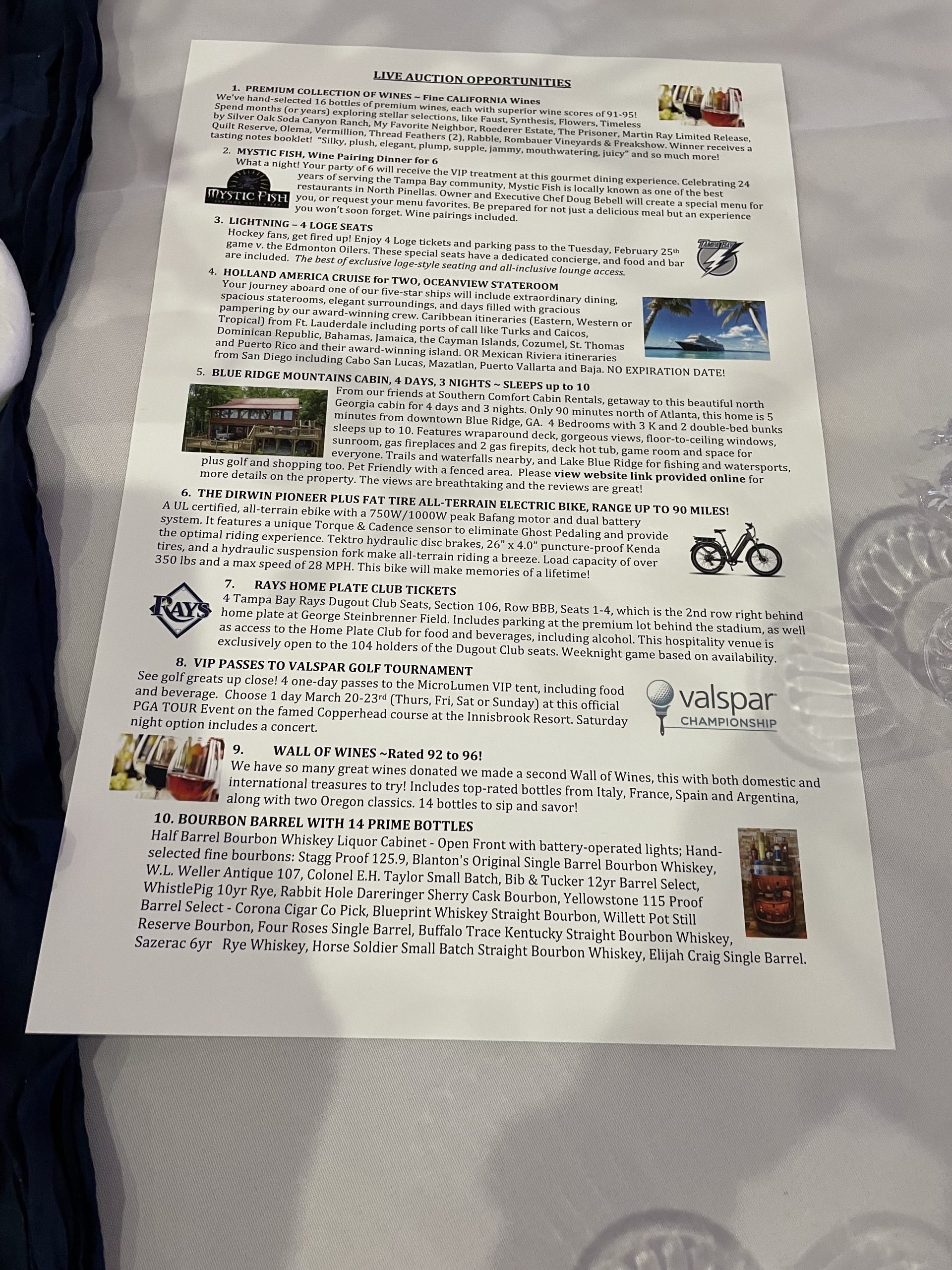
a handout with text and small images

When I teach my 3-day BOOTCAMP for Benefit Auctioneers class to aspiring fundraisers across the country, one part of Tab 1 is an entire seminar condensed into a few pages called “65 Ways to Create Prepared Bidders.” Yes, there are literally at least 65 ways that you and your auctioneer can creatively promote your live auction items and get your attendees educated and excited for what’s next.

One of the simplest, cheapest and most effective is a large Live Auction Handout. The one shown fully explains 10 items and has an image for each. We choose to do this on a 11″ x 14″ sheet so that the text is actually readable, but you could use both sides of a smaller size. This is inexpensive and practical because it can be edited up to the final day for accuracy (instead of catalog descriptions written 2 weeks prior).

THERE IS NO DOWNSIDE TO PREPARING YOUR GUESTS TO GIVE. Seriously, a little louder for those in the back, as they say. You get one night, once a year. Do everything you can to create prepared bidders who are excited about the upcoming opportunities instead of dreading your auction.

Comments are closed - Categories: Better Buyers, Consulting, Event Logistics, Great Ideas, Live Auctions


►When a Bidder Backs Out-Part Two

March 11, 2020 - Author: Jenelle Taylor, CAI BAS

See Part One for 3 things you can do to (hopefully) safeguard your gala and stop this from happening, but, if it happens, here’s what you can do:

(Excerpt from a recent conversation with a client:)

I would 
-start by trying to address the exact issue: is the winning bidder just now realizing the blackout or expiration dates? If so, contact the donor to see if you have any wiggle room. Is the amount of the purchase too much at one time? Offer to break up their total into payments. Is the top bidder claiming, “It wasn’t me?” Show him or her your back-up confirmation system, whether clerk sheet, signature, video of the auction, or all 3. Did anyone from your team have a conversation with the winner immediately after the purchase? Your bidder may still back out, but make sure you’ve done all you can, because trying to sell an item after the event can be a headache.

If you’ve tried your best to be diplomatic and solve the issue to no avail, ask the person who no longer wants their live auction item if they’d like to donate the item back and instead make a 100% tax-deductible straight donation to your organization. I’ve seen this done multiple times.

If you still end up with the auction item, you now have to monetize it somehow.

  1. Is there an upcoming event you can use it for? Will the expiration (if applicable) still be far enough in advance? If that event isn’t suited for this size or type of prize as a live auction item, could it become a raffle that you sell chances to win for over time? (check your local raffle statutes).
  2. Can you sell it internally, to a board member or staff member or volunteer?
  3. If you have to open it back up for bidding or buying, try the guests who were in the room and heard the promotion/saw the images.
    Email every table host individually and say something like
    “Thank you for attending and supporting us! We had a wonderful night and are so thankful for you and your guests.We have some exciting news! We have something in the works where guests may be able to still place a bid for a _________________ valued up to _____________. We’ve spoken with (donor) and the offering would be___________________________. (Our auctioneer thinks) there may have been a guest at your table bidding during the Live Auction, and we wanted to extend this opportunity. If you know of a guest who had been bidding, we’d love to share this updated info with him or her.”

If you don’t get any responses from that, you can put the item on your website or an online bidding platform to find a new offer (or two or three).

As I said to my client, “I’m sorry this happened. Sometimes people are…people.” 

Comments are closed - Categories: Better Buyers, Board members, Consulting, GALA GAL Case Study, Live Auctions

►When a Bidder Backs Out-Part One

- Author: Jenelle Taylor, CAI BAS

It happens.

Not very often, but it happens.

Sometimes it’s because the person drank too much. Beware of Open Bar combined with a too-late live auction. It’s an urban myth that you should get your guests drunk so they “bid more.” Drunk is NOT the goal, should never be the goal. The guideline fundraising professionals use is “Two drinks good, 3 drinks bad.” Get your fundraising FINISHED before your guests have finished a third drink. People who’ve had too much to drink (more than 2-3) tend to be louder, talkative, self-absorbed, unable to focus on the larger agenda of the whole room, and -in extreme cases -not thinking clearly. Oh they might bid, but they’re the first ones to cry “buyer’s remorse” and refuse to pay, leaving you with a multi-thousand dollar auction item and no crowd left (on Monday after the event) to sell it to.

There are other reasons people refuse to honor their auction bid, and there are a few ways you can minimize your risk, so start building these safeguards into your next event:

  1. Videotape your live auction and paddle raise appeal. If you’ve got them on video raising their Bid Number, it will be harder to claim it was a mistake.
  2. Get an instant confirmation after each item is sold. We often create a separate invoice for each live auction item and a runner gets an immediate “Print, Phone, Signature” – printed name, phone and confirming signature acknowledging the item and the purchase price. If using mobile bidding, one of the reps can go to each winner and immediate confirm acceptance by asking for his/her phone number to tie that item to an account on file.
  3. Make sure your clerks are writing down the back-up bidders, too, in case you need to reach out to them after the event. (Side note: remember that ALL bidders during your live auction – everyone who raises a bid number – was trying to give you money that night, and only a few were the final winning bidders. It’s a GREAT idea to follow up with all bidders after the event and thank them, see if you can interest them in supporting in another way, invite them to join the committee for next year’s auction, etc.)

Despite all of your efforts, someone calls on Monday and backs out/won’t honor their bid. Now what?

Check out Part Two…

Comments are closed - Categories: Better Buyers, Consulting, Event Logistics, Live Auctions

►Cruise Raffle

August 23, 2017 - Author: Jenelle Taylor, CAI BAS

lapel pin of blinking ship

Selling chances to win for that cruise or yacht trip!

Ah, the Chance to Win, doesn’t most every event have one?

Of course, the very first thing you need to do is familiarize yourself with your state’s (and sometimes city) raffle, gaming, gambling, drawing statutes.

Did you know that in Florida, you can’t require anyone to pay for a ticket?

Print out the Florida statute here.

Once you know the rules, this is a great option for the “blinky lights” pin to show who bought a chance to win (and, obviously, who hasn’t yet).

Do you know that Holland America has a reduced-price program that your nonprofit might qualify for? It’s a great program with a reasonable fixed cost, and never expires. Check it out here.

If you’re selling chances to win a cruise or a yacht excursion, instead of generic pins consider these cute things, found at FlashingBlinkyLights.com. It’s themed, flashy, and if you don’t want to pin into guests’ fancy clothes, then simply attach each to a lanyard or a wrist-tie ribbon like my client.

Here’s to selling those chances and raising big money!

Comments are closed - Categories: Better Buyers, Consulting, Event Logistics, Other Money Makers, Raffles/Chance Drawings

►”Lucky Line” with Mobile Bidding

August 16, 2017 - Author: Jenelle Taylor, CAI BAS

photo of mobile bidding incentive caption

Using Mobile Bidding? Add an incentive to get guests to Bid More!

Do you use the “Lucky Line” for your traditional silent auction bids on paper?

It’s a way to encourage folks to be more generous, give a little more, just jump down a few bidding lines rather than the next bid available. I’ve got an explanation in a viewable Google doc here.

For years we (the benefit auctioneer community) have been trying to replicate this bidder incentive with handheld mobile/text bidding, but to date most mobile technology companies haven’t figured out a way to virtually highlight only bids past a certain point, and then segregate just those for a random winner.

And then my new client shared a semi-solution!

While the one “who makes the most bids” isn’t random and may not encourage as many people to try for the prize as the Lucky Line highlighting does, it certainly is trackable in mobile bidding reports, AND worth celebrating and rewarding! Using the technique above, the organization rewards participation, not dollars, which is an equalizer of sorts.

How have you figured out ways to incentivize more bidding using technology?


Comments are closed - Categories: Better Buyers, Consulting, Event Logistics, Other Money Makers, Silent auctions, Technology

►Mobile Bidding Considerations

July 7, 2015 - Author: Jenelle Taylor, CAI BAS

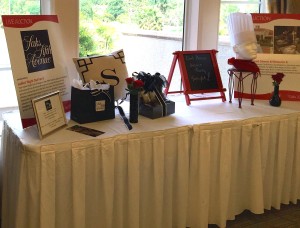
photo of auction display

Auction Bidding is Enhanced by Displays

Today a client asked me

“Quick question – mobile bidding. Does it enhance an auction? Have you seen increased participation (read larger bids) utilizing mobile bidding?”

and I replied:

 Good question!

Typically mobile only makes sense when there are a lot of attendees, a lot of auction items (100+) and the silent auction revenue is $30,000+.

Pros:

IF people use it, they can set max bids and not have to either log back in or walk to a table – most mobile bidding systems can just continue to bid for them up to a set maximum.

Auction displays can take less space

Everyone can see all the auction items if they wish (on a device) without walking around

You can close the bidding later

Cons:

Typically costs $3000-$5000+

Either you have to pay for one of the mobile company’s staff to be on site (could add $1000), or you’re 100% responsible for any kinks or problems. Unless you have a savvy tech person, this could add significant stress.

It can be hard to get people to engage in mobile bidding for several reasons:

 ~Some require downloading an app, though some just have a web address people key in

~Some say mobile is less social, since people move around less and must spend time staring at their phones

~Requires either than people use their cell phone data plans (and battery life) or the club has a reliable wi-fi connection that’s open to everyone; some mobile systems rely on wi-fi and can get bogged down or crash

Results:

Whether or not mobile adds revenue above and beyond the cost of using the technology is a source of heated debate! Just a few weeks ago auctioneers from around the country shared mixed reviews in an online forum. When the technology works as promised,  is adopted by the attendees and gets used, certainly there are benefits to being able to shop from anywhere in the venue and not have to physically revisit a bid sheet.

On the other side, paper silent auctions have worked for decades by generating that person-to-person, last-minute competitive bidding atmosphere, especially when your professional auctioneer is making announcements and making the auction closings fun for everyone in the room.

What mobile definitely does is eliminate the need to clerk, record, tally or key in silent auction purchases once bidding closes, and for some groups, that fact alone makes the technology worth several thousand dollars, just to eliminate checkout!

 There are 10-12 major mobile bidding companies nationwide, all scrambling for footing and market share. All have demos you can do or samples you can view.

Industry software leader Greater Giving has great educational info with just about everything you need to know about mobile here.

Because of the many pros and cons (and how those affect your overall revenue/schedule/logistics), it’s something you should ask your professional auctioneer about as early as possible.

Like this great client of mine did! Thanks for the question, Sara 🙂

Comments are closed - Categories: Better Buyers, Consulting, Event Logistics, Silent auctions, Technology

►Raffle pricing

May 1, 2015 - Author: Jenelle Taylor, CAI BAS

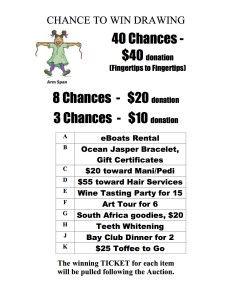
poster showing raffle ticket pricing

Fingertips for $40

Recently a client asked me about raffle (Chance to Win drawings) pricing.

“I found this on-line as a guideline to selling tickets. Does this make sense?

Raffle ticket sales:  3 tickets for $5, 6 tickets for $10 and finger tip- to-finger tip $20″

Here’s my take:

1. Raffle chance pricing depends on the value of the prizes to be won.

2. Calculate the math equation: How much do you want the raffle to raise (have a goal),  who will be asked to buy tickets and what pricing feels exciting to them, and how many tickets (at what level) can you expect to sell? PRICE x QUANTITY = MONEY RAISED

3. In the example you found, “3-$5 and 6-$10” are the same odds, so there’s no incentive to spend $10 rather than $5.

4. The PURPOSE of unequal odds (increased chances for paying more) is to wildly slant the odds in favor of those more generous. We want to encourage folks to donate more. In Florida (and other states-check your state gaming statutes*) all chances to win do not have to be equal.

5. So, I like

3 – $10, 8 for $20, or fingertip-to-fingertip for $40.

That way the focus is just on selling $40 worth, and if someone is considering $20, have them grab a friend and get tons more chances by splitting the fingertip-to-fingertip (which might be 40-ish tickets)

If the prize(s) are smaller, you could go with 2-$5, 7-$10, fingertips for $20

*A reminder to always know and follow your state regulations on raffles, which often fall under gambling policies. In some states, nonprofits are limited to one per year or need a special license. In Florida (and other states) drawings are required to have a “no purpose necessary to be entered” option, which is why setting any pricing for a chance drawing must be disclosed as a “suggested donation” See the Florida statute here, and happy fundraising!

Comments are closed - Categories: Better Buyers, Charity, Consulting, Event Logistics, Other Money Makers, Raffles/Chance Drawings, Templates

►Another reason you need a female auctioneer!

April 17, 2015 - Author: Jenelle Taylor, CAI BAS

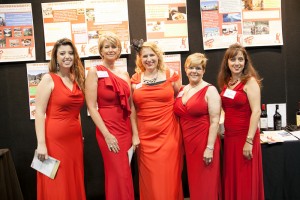
photo of Gala Gal and team

Study says men give more when the person fundraising is attractive

This morning I read a piece entitled “Men Strive To Give More To Charity When The Fundraiser Is Cute.”

Believe it or not, researchers found that both men and women donated more to online campaigns after they saw how much others had given. The men, however, gave an even larger increase to attractive females.

If that happened just by looking at a photo of the female asking for donations, could it be that the effect is magnified in person? When you put a charismatic, attractive female auctioneer on stage and give her a microphone to engage people about your cause, might that increase the competitive bidding in your audience? Think about it, every single time he or she bids again, that’s more dollars raised for you!

Combining the “all eyes on me” aspect of live auctions with a smiling, friendly female face is your recipe for awesome auction results.

Just ask my clients!

Comments are closed - Categories: About GALA GAL, Auctioneers, Better Buyers, Charity, Consulting, Live Auctions

►Silent Auction – Bidder Blockers and Sheet Stealers

March 19, 2015 - Author: Jenelle Taylor, CAI BAS

photo of Gala Gal

Don’t let those “bid blockers” and “sheet stealers” ruin your auction!

If you’ve never seen one at your event, you’re lucky! While it’s great to have fast and furious bidding on your silent auction items, and it’s fun to watch that competition, too many times I’ve heard (or seen) heated bidders try to bend or break the rules of fair play.

I’ve seen Bid Blockers who square their shoulders and won’t let anyone else get to the bid sheet to bid against them, or Sheet Stealers who actually pick up or hide the bid sheet and try to sneak it back on the table right before closing time! I’ve actually seen someone rip up a bid sheet…twice! The same guy!

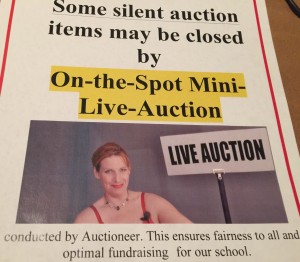
Anyway, if every year a few of your classroom projects or priceless opportunities create more bad blood than goodwill among your bidders, you’ve got a few options: either move those items to the main Live Auction, where peer pressure and encouragement will spur on the bidding, or post signs and make announcements reminding people that if your auctioneer sees a bidding war heat up, she plans to step over there and see who really wants it the most with an on-the-spot, mini live auction. It’s fun, it’s fast, and it’s fair.

But make sure to warn people first. And, of course, if you use mobile bidding for your silent auction, you’ll never have this issue again 🙂

What are your auctions most highly contested items year after year? How have you solved it?

Comments are closed - Categories: Better Buyers, Consulting, Event Logistics, Silent auctions

►Silent Auction, or Mini On-the-Spot Live Auction?

March 10, 2015 - Author: Jenelle Taylor, CAI BAS

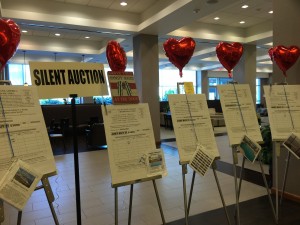
photo of easels with poster-sized bid sheets

Draw attention to a row of Can’t Miss items

What to do when you have so many great auction items that you can’t even fit them all in to the time slotted for the Live Auction?

Most live auctions at charity events are 30-45 minutes, and with an industry average of 3-4 minutes per live auction sale, that means only 10-15 items make the Live Auction cut for many events.

What if you have 20 awesome items that you need to get in front of bidders? I suggest blowing up the bid sheets to 20″ x 30″ mounted on foam board, place them on easels in a very high traffic area, add signage, place 1-2 full-time volunteers who never leave and can answer all questions about the items, and then get into the mindset of a county fair carnival barker, “Ladies and Gentlemen, don’t miss this awesome opportunity right here. Step right up to bid on ….” You get the idea.

Sometimes, I place these easel items in a semi-circle directly in front of the ballroom doors, and I let the crowd know that these items -while available for normal bidding during the silent auction – will be closed by on-the-spot, mini live auction between 7:40-7:45, immediately before the doors open for dinner. All interested in bidding need to gather here at 7:40 to get a last chance to be the winning bidder.

By doing this, we get as close as we can to the energy, excitement and ego of a live auction even though there wasn’t time in the program. As guests gather, I gets everyone’s attention in the vicinity and say, “Ladies and Gentlemen, we’re now going to close these 5 SUPER silent auction items by mini live auction. They are such great items that we didn’t want anyone to miss the opportunity, so whether you’ve already bid or not, everyone is welcome to bid right now as we close these awesome items. First up, you’ve been bidding on Item 901, 1 week RCI Timeshare anywhere in the world, valued up to $1800. The current bid is $1200, but who’ll go $1300, do I hear $1300, yes and now $1400…” Each item will take just seconds to close, and inevitably we’ll raise several hundred more dollars, remind folks that a professional auctioneer will entertain them later, and generate auction closing excitement right before releasing the guests to dinner.
Win. Win. Win!

Comments are closed - Categories: Better Buyers, Consulting, Event Logistics, Live Auctions, Silent auctions